
Trinity
According to historians, the word “Trinity” was coined in the late 2nd century AD by Theophilus1 and was eventually adopted at the council of Nicaea in 325 AD as part of the Nicene Creed2. Trinitarians believe that the doctrine is not a new doctrine but instead a new label for a concept that exists in the Bible. On that basis it should be possible to prove the Trinity from the Bible.
The fundamental concept of the Trinity is often described as a “mystery”.3 This mystery makes the exact details very difficult to pin down which in turn makes it a very difficult doctrine to prove or disprove and is sometimes an argument that is offered when flaws in the doctrine are highlighted. The Bible does include several “mysteries” but in almost every case the mystery is is explained. For example, the most obvious example is Jesus Christ, who is described in Colossians 2 as “God’s mystery”4. But Paul elucidates on this mystery in Ephesians 3:
by which, when you read, you can perceive my understanding in the mystery of Christ; which in other generations was not made known to the children of men, as it has now been revealed to his holy apostles and prophets in the Spirit; that the Gentiles are fellow heirs, and fellow members of the body, and fellow partakers of his promise in Christ Jesus through the Good News,
(Eph 3:4-6)
Other mysteries include the “kingdom of God5“, the resurrection6, marriage (as a figure of the relationship between Jesus and the “church”)7 and the gospel8.
The one verse that could be attributed to the mystery of the Trinity is 1 Timothy 3:16
Without controversy, the mystery of godliness is great: God was revealed in the flesh, justified in the spirit, seen by angels, preached among the nations, believed on in the world, and received up in glory.
(1Ti 3:16)
At first glance, this verse seems to support the suppositon that God and Jesus were the same person “God was revealed in the flesh” but another possible explanation is God Manifestation. If this were the one and only reference to the mystery of the Trinity, it would make it a very vexing verse that Paul would drop a hint to some “new” mystery and then provide absolutely no more detail or context about it. What is far more likely is that he is referring to the “mystery of Christ” that as mentioned, is a theme that is taken up and explained well in Romans and Ephesians.
It is therefore intellectually and spiritually unacceptable for the Trinity to be accepted without a proper foundation from the Bible.
What is the Trinity Supposed to Be?
“[The Trinity is] one God existing in three coeternal, consubstantial divine persons: God the Father, God the Son (Jesus Christ), and God the Holy Spirit, three distinct persons (hypostases) sharing one essence/substance/nature (homoousion).9
“Consubstantial” means ” of the same substance”. A common example of this concept presented diagramtically is:
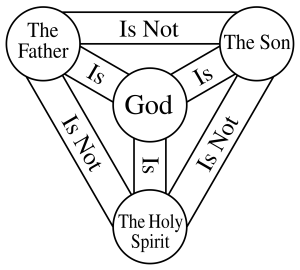
The basic logical challenge that the Trinity presents is that it claims two multually exclusive facts to be be true:
- God is one
- God is three
It then (unsuccessfully) attempts to explain these contradictions by intellectual sleigh of hand.
Nonetheless, the doctrine of the Trinity was not manufactured out of thin air. There are some bible passages that when read in isolation and without a proper understanding of the underlying language do appear to support the idea of God being non-singular but at the same time there are many passages that unequivocally state that “God is one”11 and that Jesus is a separate being from God. An explanation of these apparent contradictions is necessary. Unfortunately, the Trinity is a failed and ultimately destructive attempt to explain these passages since it corrupts some of the foundational principles of the nature of God.
- Theophilus, Apologia ad Autolycum, Book II, Chapter 15 ↩︎
- https://www.usccb.org/prayers/nicene-creed ↩︎
- https://www.catholiccrossreference.online/catechism/#!/search/234 ↩︎
- Colossian 2:2-3 ↩︎
- Luke 8:10 ↩︎
- 1 Corthian 15:51 ↩︎
- Ephesian 5:32 ↩︎
- Ephesians 6:19 ↩︎
- https://en.wikipedia.org/wiki/Trinity#cite_note-h502-111 ↩︎
- By User:AnonMoos (earlier version of SVG file Sumudu Fernando) – Own workConverted to SVG from the following vector PostScript source code:Source code%!/!{def}def/N{counttomark}!/Q{grestore}!/r{rotate}!/p{N 2idiv{N -2 roll rlineto}repeat}!/q{gsave}!/m{moveto}!/M{x]makefont setfont}!/x{0 0}!/O{show}!/t{/Times-Romanfindfont}!/c{newpath 55 0 360 arc q 1 setgray fill Ql}!/l{stroke}!/v{rmoveto}!/o{scalefont setfont}! mark2.5 setlinewidth/X{t 36 o}!/Z{X(Is Not)O}!/W{X(Is)O}! 2120 translate 95.587 575.075 m 180.598 -104.434 0-208.241 47.63 x 208.241 180.587 104.434 -23.815 41.25-180.587 -104.434 -181.137 104.434 p l 142.141 575.7 m157.859 -273.3 157.859 273.3 -315.718 0 p l 89.641571.04 m 180.359 -312.39 60 0 180.359 312.39 -30 51.96-360.718 0 p l 254 586.5 m Z q 60 r 526 -145 m Z Q q -60r -315 375 m Z Q 300 484.391 c 140.491 575.7 c 459.509575.7 c 300 302.4 c q 30 r 580 257 m W Q q -30 r -87 558m W Q q -90 r -407 289 m W Q t[30 x 32 M 116.641 586m(The )O 102.641 555 m(F)O -1 0 v(ather)O 410.109 568m(The )O -.5 0 v(Son)O 262 471 m t 42 o(God)O t[26 x 30M 252.5 300.75 m(The )O -1.75 0 v(Holy)O 271.5 271m(Spirit)O pop showpage%EOF, Public Domain, https://commons.wikimedia.org/w/index.php?curid=8256706 ↩︎
- Deut 6:4 ↩︎